"Earth, the only planet with free choice in the Milky Way Galaxy"

“.. A billion years ago, they (Pleiadians) went through a change and they went through a shift, and they had free choice. Back then, they were the only planet that did in their time, and eventually they went through a metamorphosis of consciousness. ”

“.. So again, we tell you that the ones who came to help seed you approximately 100,000 to 200,000 Earth years ago were the Pleiadians who had gone into graduate status and who had changed consciousness. They had become quantum with free choice, and you have parts of their DNA within you. ..”

“..You're surrounded by divine beings who keep you safe and will continue while this planet of only free choice – the only one at the moment – makes its decision. You're turning the corner of consciousness and they all know it, for they've all been through it and they remember it. Oh dear ones, consciousness is volatile! You've seen it change so slowly, but it's about to change faster. It's not going to take generations and generations as in the past. Instead, you're going to see real-time changes. Humans won't wait to have children for them to grow up and have children. ..”


"The Quantum Factor" – Apr 10, 2011 (Kryon channeled by Lee Carroll) (Subjects: Galaxies, Universe, Intelligent design, Benevolent design, Aliens, Nikola Tesla (Quantum energy), Inter-Planetary Travel, DNA, Genes, Stem Cells, Cells, Rejuvenation, Shift of Human Consciousness, Spontaneous Remission, Religion, Dictators, Africa, China, Nuclear Power, Sustainable Development, Animals, Global Unity.. etc.) - (Text Version)

“.. In time, the quantum factor will be discovered on this planet. When it is, it will be highly controversial, and it's going to fly in the face of logic and 3D and the way things work via the scientific method. The ramp-up to all this is difficult. The old souls in front of me have signed on to work this new energy and they've waded through lifetimes, just waiting for this. What would you do as a scientist if the experiments before you had "a mind of their own"? What would you think if magnetics, gravity and light could only be assembled in a certain way that created healing and never a destructive alignment? All this is going to redefine some of the basic forces in the Universe. Intelligent design is only the first, and even today many astronomers and physicists still think it's an anomaly. 

That will be the next largest discovery on the planet. It's been held back from you because it takes a higher vibrating consciousness to create and understand it. When any planet discovers a quantum energy and is able to use it, you could go to that planet and know that you will meet high-consciousness entities. This has never been given to you before that, for within the quantum factor contains the secret of interplanetary travel using large, entangled states. There are ways of doing things you never thought could happen. You can throw away your rocket ships. You're on the edge of that.  ..”

“… And so, dear Human Being, you have the ability to start to return to an energy that you thought you'd lost, where Human beings are allowed to live longer and it doesn't destroy the environment. They don't overcrowd themselves because they can control it through their minds instead of laws... and through wisdom.

Some day you'll meet the star seeds, your Pleiadian sisters and brothers. They're even here now, since they are quantum. You've got Pleiadian ancestors who live a very, very long time in a graduate situation in a planet that went through the test just like yours. And it developed a quantum factor. They have benevolence and they have quantum energy. That's how they get here instantly and return, and they'll never interrupt your free choice. That's also why they don't land and say hello. Instead, they sit and cheer on the sidelines for what you've finally done. They are waiting with you to celebrate the December solstice of 2012... the half way point of the 36 year shift you are in. …”

"Demystifying the future" + "Physics in the next 500 years"(#) - May 16-17, 2014 (Kryon Channelling by Lee Carroll) - (#) (This channel will become a historical channel in the future, prove that Kryon is a real communication from the Creative Source/God to Humanity - "Our Family") - (Text version "Physics in the next 500 years")

1 To seea nd measure multi-dimensional/quantum physics, instrument (super-cooling quantum plasma lens)

2 Two more laws of multi-dimensional physics revealed: explanation of dark matter & acknowledgement of free energy (controlling mass)

3 God in the atom. God has - provable - part in physics. Intelligent/benevolent design. (Will bring religion and science together)

4 Human Consciousness is an attribute of physics. (Pleiadians - Humans ancestors / Humans free choice only planet in the Milky Way Galaxy. Other galaxies have their own spiritual systems and physics)

5 Coherent DNA. Multidimensional DNA coherent between dimensions will give Enhanced DNA

The Key to Life is Balance

The Key to Life is Balance

Blossom Goodchild and White Cloud Live! (12 November 2020)

ABSOLUTE PROOF THE CHANGE HAS BEGUN. Blossom and White Cloud speak.

UFO's / ET's

UFO's / ET's
One of the first of many UFO photographs taken by Carlos Diaz-Mexico.
.
Lee Carroll is an American channeller, speaker and author.
Originally an audio engineer, Carroll claims that he began to channel communication with an entity from a higher dimension called Kryon in 1989. He describes Kryon as an angelic loving entity from the Source (or "Central Sun") who has been with the Earth "since the beginning" and belonging to the same "Family" of Archangel Michael.
.
The information he publishes, both printed and online, is intended to help humans ascend to a higher vibrational level.

Greg Braden "If we are honest, truthful, considerate, caring and compassionate, if we live this each day, we have already prepared for whatever could possibly come on 2012 or any other day, any other year, any time in our future."

The annual Perseid meteor shower

The annual Perseid meteor shower
Google: The annual Perseid meteor shower is happening now in today’s doodle on our home page. (11 Aug 2014)
Showing posts with label Comet. Show all posts

Saturday, May 28, 2016

Comet contains glycine, key part of recipe for life

Yahoo – AFP,  May 27, 2016

Glycine, an organic compound contained in proteins, was found in the cloud around
 Comet 67P/Churyumov-Gerasimenko by the European Space Agency's probe,
Rosetta (AFP Photo)

Miami (AFP) - An important amino acid called glycine has been detected in a comet for the first time, supporting the theory that these cosmic bodies delivered the ingredients for life on Earth, researchers said Friday.

Glycine, an organic compound contained in proteins, was found in the cloud around Comet 67P/Churyumov-Gerasimenko by the European Space Agency's probe, Rosetta, said the study in the journal Science Advances.

The discovery was made using an instrument on the probe, called the Rosetta Orbiter Spectrometer for Ion and Neutral Analysis (ROSINA) mass spectrometer.

"This is the first unambiguous detection of glycine in the thin atmosphere of a comet," said lead author Kathrin Altwegg, principal investigator of the ROSINA instrument at the Center of Space and Habitability of the University of Bern.

In addition to the simple amino acid glycine, the instrument also found phosphorus. The two are key components of DNA and cell membranes.

Glycine has been detected in the clouds around comets before, but in previous cases scientists could not rule out the possibility of Earthly contamination.

This time, however, they could, because the mass spectrometer directly detected the glycine, and there was no need for a chemical sample preparation that could have introduced contamination.

"The multitude of organic molecules already identified by ROSINA, now joined by the exciting confirmation of fundamental ingredients like glycine and phosphorus, confirms our idea that comets have the potential to deliver key molecules for prebiotic chemistry," said Matt Taylor, Rosetta project scientist of the European Space Agency ESA.

"Demonstrating that comets are reservoirs of primitive material in the Solar System, and vessels that could have transported these vital ingredients to Earth, is one of the key goals of the Rosetta mission, and we are delighted with this result."

Scientists have long debated the question of whether comets and asteroids brought the components of life to Earth by smashing into oceans on our planet.

More than one hundred molecules have been detected on comets and in their dust and gas clouds, including many amino acids.

Previous data from Rosetta has shown that water on Comet 67P/C-G is significantly different from water on Earth, suggesting that comets did not play as big a role in delivering water as once thought.

However, the latest finding shows "they certainly had the potential to deliver life's ingredients," said a statement by the University of Bern.

Related Article:


Wednesday, October 28, 2015

Discovery of oxygen on comet 'big surprise'

Yahoo – AFP, Marlowe Hood, 28 Oct 2015

In a "big surprise," scientists have found lots of oxygen on Comet
 67P/ChuryumovGerasimenko, captured by the European space probe Rosetta 
an hour before its closest approach to the sun on August 13, 2015 (AFP Photo)

Paris (AFP) - Stunned scientists announced Wednesday the unexpected discovery of large quantities of oxygen on a comet which streaked past the Sun in August with a European spacecraft in tow.

The find came as a "big surprise" and challenges mainstream theories on the formation of our Solar System, said scientist Andre Bieler of the University of Michigan.

Measurements made by the Rosetta probe suggested that oxygen molecules in the 67P comet's gassy halo must have existed "before or at" its formation, he told journalists.

This may have implications for mankind's understanding of the chemistry involved in the formation of the Solar System some 4.6 billion years ago.

"We believe this oxygen is primordial, which means it is older than our Solar System," said Bieler.

Scientists had previously ruled out the presence of oxygen (O2) on comets such as 67P/Churyumov-Gerasimenko, the subject of intensive prodding and probing by a European robot lab.

As O2 mixes easily with other elements, "we never thought that oxygen could 'survive' for billions of years" in a pristine state, said Kathrin Altwegg of the University of Bern, who co-authored a study in the journal Nature.

"This evidence of oxygen as an ancient substance will likely discredit some theoretical models of the formation of our Solar System," she said.

The comet is being tracked on its deep-space journey around the Sun by the European Space Agency's Rosetta spacecraft.

The historic mission seeks to unlock the mystery of the origins of life on Earth.

Scientists believe that comets "seeded" early Earth with some of the ingredients for life.

The team monitored the ratio of oxygen to water on the comet for several months to see if the gas molecules would dissipate as solar winds ripped away layers of surface.

They did not -- proving the oxygen was embedded in the comet, not just hanging around its surface.

Prevailing theories of the Solar System's birth posit a chaotic, collision-strewn mixing of matter flowing toward and away from the newly formed Sun.

Pristine, icy grains containing oxygen would not have made it through such violence intact, the scientists said, leading them to speculate that the process was, in fact, "gentler".

The oxygen molecules must have "survived from the dark molecular clouds from which they were probably formed into comets as we have them today," said Altwegg.

Only twice before -- on the icy moons of Jupiter and Saturn -- have oxygen molecules been found in the Solar System beyond Earth's atmosphere, and never before on a comet.

Oxygen is difficult to detect with Earth-bound telescopes.

'Don't jump to conclusions'

Rosetta offered a rare opportunity to study 67P's "coma" -- the envelope of dust, gas and ice that forms as it nears the Sun on an elliptical orbit.

The new data suggests that water on comets is probably the rule rather than the exception, the scientists said.

Scientists not involved in this study underlined its importance, but said more time was needed to assess the implications.

The discovery "imposes a severe constraint on the mechanism for the formation of the Solar System," said French astrophysicist Francis Rocard.

"But we shouldn't jump to conclusions," he cautioned.

Oxygen molecules were the fourth-most common gas detected in 67P's debris halo -- after water, carbon monoxide and carbon dioxide.

Their presence did not tell us anything about the origins of life on Earth, of the possibility of finding it elsewhere in the universe, Altwegg said.

In looking at exo-planets, "the combination of O2 and methane has been taken as a sign that you might have life underneath," she said.

"On this comet we have both, but we don't have life. So having oxygen may not be a very good bio-signature."

Related Article:


Tuesday, December 16, 2014

Methane ‘spikes’ fuel speculation of life on Mars

Nasa’s Curiosity rover measures fluctuations of gas not easily explained by geology or organic material dropped by meteorites

The GuardianIan Sample and agencies,16 December 2014

The sun rises over Gale Crater on Mars where the Curiosity rover detected
the methane fluctuations. Photograph: Stocktrek Images/Alamy

Nasa’s robotic rover, Curiosity, has detected fluctuating wafts of methane on Mars, fuelling speculation that the gas may be coming from a form of life on the red planet.

An instrument on the six-wheeled robot measured mysterious spikes of methane that cannot easily be explained by geology or organic material transported to the planet by comets or asteroids.

“That we detect methane in the atmosphere on Mars is not an argument that we have found evidence of life on Mars, but it’s one of the few hypotheses that we can propose that we must consider,” John Grotzinger, a scientist on the Curiosity team, told the American Geophysical Union meeting in San Francisco. “Large organic molecules present in ancient rocks on Mars is also not an argument that there was once life on ancient Mars, but it is the kind of material you’d look for if life had ever originated on Mars.”

The instrument recorded a 10-fold increase in methane in the atmosphere around it and detected other organic molecules in powdered rock collected by the rover’s drill, the first definitive detection of organics in surface materials of Mars. These organics could either have formed on Mars or landed on Mars via meteorites.

“This temporary increase in methane, sharply up and then back down, tells us there must be some relatively localised source,” said Sushil Atreya, of the Curiosity science team at the University of Michigan in Ann Arbor. “There are many possible sources, biological or non-biological, such as interaction of water and rock.”

Mars satellites have detected plumes of methane from the surface before, but none as extraordinary as the sudden venting of the gas measured at Gale Crater, where evidence suggests water once flowed billions of years ago.

Curiosity, one of Nasa’s two Mars exploration rovers, landed in the 96-mile-wide crater in August 2012 and has been exploring the region since. Last year the US space agency reported that Gale contained the remains of an ancient freshwater lake that may have been a hospitable environment for life in the distant past. 

 A computer-generated image of the
Curiosity rover. Photograph: Nasa/PA
The latest discovery, reported in the journal Science, followed studies of gas samples by Curiosity’s tunable laser spectrometer (TAS), which uses intense light to carry out chemical analysis. It revealed a low background level of methane which spiked over 60 Martian days.

In four sequential measurements, Curiosity showed the methane level soaring from about 0.69 parts per billion by volume (ppbv) to 7.2 ppbv. The spikes occurred within 200 to 300 metres of each other and less than a kilometre from where the lower readings were detected.

By the time Curiosity had travelled a further kilometre, the higher methane levels had disappeared. Researchers led by Chris Webster at Nasa’s Jet Propulsion Laboratory in Pasadena, California, wrote: “The persistence of the high methane values over 60 sols (Martian days) and their sudden drop 47 sols later is not consistent with a well-mixed event, but rather with a local production or venting that, once terminated, disperses quickly.”

The wind direction indicated a source to the north of the rover.

Life is the chief producer of methane on Earth, but many non-biological processes can generate the gas.

The low background level of methane detected by Curiosity could be explained by the Sun’s rays degrading organic material possibly deposited by meteors, the Nasa scientists said. But the spikes of methane required an additional source, which was unlikely to be a recent impact by a comet or asteroid. Such an object would have had to measure several metres across and would have left a large crater, no sign of which was visible.

The short timescale of the methane spikes did not suggest the gas was released from volcanic deposits trapped in ice, called clathrates. Nor did it appear to come from the release of gaseous methane that had become bound to the soil.

The Nasa authors were cautious about jumping to conclusions, but concluded that “methanogenesis” – the formation of methane by microbial bugs known as methanogens – may be one answer to the riddle.

“Our measurements spanning a full Mars year indicate that trace quantities of methane are being generated on Mars by more than one mechanism or a combination of proposed mechanisms – including methanogenesis either today or released from past reservoirs, or both.”

Monica Grady, a planetary scientist at Open University, said: “They have repeated their measurements over an extended period of time, and performed careful calibrations, so I’m sure the data are good.

“They consider several different origins, including destruction by UV radiation of in-falling organic material from interplanetary dust and meteorites, release from clathrates and even methane-generating bugs. Without additional data, such as knowing the carbon and hydrogen isotopic composition of the gas, it is difficult to assign a specific source. My own preference, based on nothing other than instinct, would be to go for clathrates rather than bugs.”

Gale Crater

Gale Crater, on the Martian equator, was created when a large meteor struck the planet 3.5bn to 3.8bn years ago. At its centre is a high mountain, named Mount Sharp, that rises 18,000ft above the crater floor. Flowing water appears to have carved channels in the sides of the mountain and the crater walls.

Another major discovery by Curiosity was that of water bound in the fine-grained soil within the crater. Each cubic foot of Martian soil was found to contain around two pints of water, not freely accessible but attached to minerals.

The rover has reached the base of Mount Sharp and over the coming months will begin a slow ascent. Scientists are keen to explore the mountain because its sedimentary layers provide snapshots of Martian history.

The question of whether there is, or was, life on Mars may finally be answered by the European Space Agency’s ExoMars mission, which will land a 300kg rover there in 2019. It will be equipped with a two-metre drill and the ability to detect biomarkers of life. It will not be heading for Gale Crater, however. Because it will land with less precision than Curiosity, the crater and its mountain are considered too potentially hazardous. 

Related Articles:

Thursday, December 11, 2014

Rosetta Suggests Earth’s Water Came From Asteroids, Not Comets

Jakarta Globe – AFP, Dec 11, 2014

This NASA photo obtained on Dec. 10, 2014 shows from the International Space
 Station, a photo taken by Expedition 42 Commander Barry Wilmore of the Great
Lakes and central US on Dec. 7, 2014. (AFP Photo/NASA/Barry Wilmore)

Washington. Water on Earth is more likely to have come from asteroids that hit our planet billions of years ago than comets, European researchers said on Wednesday.

Mankind’s first-ever probe of a comet came last month when the European Space Agency’s Philae lander touched down on the duck-shaped 67P/Churyumov-Gerasimenko comet, but the latest report in the journal Science comes from an instrument aboard the Rosetta spacecraft that has been studying the comet’s interior since August.

“We have to conclude … the terrestrial water was brought by asteroids more likely than comets,” said Kathrin Altwegg, principal investigator on the ROSINA mass spectrometer that has been examining the chemical fingerprint of water and other gases in the comet.

The report in the peer-reviewed US journal is based on the atomic signature of water molecules from the comet, showing that they are vastly different from water on Earth.

Scientists measure the ratio between deuterium, a hydrogen isotope, and hydrogen, which forms water when combined with oxygen.

The comet has shown “probably the highest level of deuterium to hydrogen ratio, the most heavy of any of the solar system’s bodies,” said Altwegg, a professor at the University of Bern in Switzerland.

The ratio is between 30 and 120 percent higher than that formed in water molecules found in Halley’s comet, which belongs to the same comet family, Jupiter, formed in the Kuiper Belt.

Such a high ratio of deuterium to hydrogen “probably means that it was formed at very low temperatures and that it could be… most probably the original material from the very, very early time of our solar system, so it’s a real treasure chest to explore how our solar system looks like 4.6 billion years ago,” she said.

On the other hand, water in asteroids has a lower deuterium/hydrogen ratio and is more similar to water on Earth.

Comets are rich in water, which is not the case for asteroids — some of which have none, said Francis Rocard, a Rosetta scientist at the France’s National Center for Space Studies (CNES).

Also, many more asteroids have been found to date (650,000) than comets (4,000), he told AFP.

“To me, these findings do not shake things up but render them a bit more complex than we previously believed, all while reinforcing the hypothesis that asteroids are the source of Earth’s water,” he told AFP.

“The ratio of deuterium to hydrogen in water is variable from one comet to another, much more so it appears than in asteroids and for the moment we are not sure why.”

Comets are the most primitive objects in the solar system and are rich in carbon, and by smashing into the Earth scientists say they may have brought elements that allowed life to exist.

The Rosetta mission, approved in 1993, aims at exploring the composition of comets, believed to be primordial clusters of ice and dust left from the building of the solar system 4.6 billion years ago.

Agence France-Presse

Thursday, November 13, 2014

Rosetta probe Philae declared 'stable'

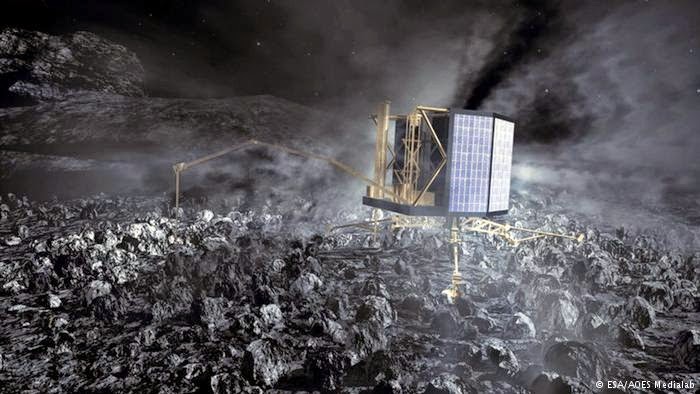
Scientists are awaiting news from the Rosetta comet mission, its Philae module landed on the surface of comet 67P. Early data suggested the probe may have hit a snag, although the situation has been declared stable.

Deutsche Welle, 13 Nov 2014


With communications severed as the "mothership" Rosetta spent a period of its orbit on the far side of the comet from Earth, information was limited about the degree of success of Philae's landing.

Mission chiefs based in the German city of Darmstadt said the European Space Agency (ESA) lander, Philae, failed to anchor to comet 67P/Churyumov-Gerasimenko, after landing on Wednesday. However, the probe still managed to send back some scientific information and was declared to be in a "stable" situation on Thursday.

The 100-kilogram (22 lb) module appears to have landed on a soft surface, but it is feared that it is not anchored. The harpoons that Philae had been due to fire to secure itself did not deploy successfully.


It is believed that the probe touched down largely as planned, except that it may have bounced once off the surface before coming to rest. "Hopefully, we are sitting there on the surface at a position different to the original landing and can continue our science," landing manager Stefan Ulamec said after Philae's descent.

Rosetta, which carried Philae on a journey of some 6.5 billion kilometers (4 billion miles) was launched into space on 2004 and took over a decade to reach its target - comet 67P/Churyumov-Gerasimenko - "Chury" or "67P" for short. It arrived in August, having been propelled to its destination by using the gravitational pull of both the Earth and Mars as a slingshot.

The probe is equipped with 10 instruments that will examine the chemistry and structure of the 67P, drilling into the comet's surface. It is hoped that the information gleaned might provide scientists with a greater understanding of the origins of the solar system.
Comets are thought to be clusters of ice and carbon dust left over from the formation of the solar system.

One theory is that comets may have seeded the Earth with water and the necessary carbon molecules for life to evolve some 4.6 billion years ago.

rc/ksb (AFP, AP, Reuters)
Related Article:


Sunday, August 10, 2014

Supermoon and Perseids meteor shower offer divine heavenly show

Astronomers and amateur skywatchers excited as perigee moon and comet Swift-Tuttle appear together for dazzling skies

theguardian.com, Press Association, Sunday 10 August 2014

The perigee moon, or supermoon, rises over Mount Eden in Auckland,
New Zealand, on Sunday morning. Photograph: Simon Runting/REX

A dramatic supermoon is set to accompany this year's Perseid meteor shower, one of the most anticipated events on the skywatcher's calendar.

Given a dark, clear sky in a normal year, it is common to see more than 100 of the meteors an hour during the second week in August. But this year the Perseids have a bright shining rival. On Sunday, two days before the meteor shower reaches its peak, the moon will become full.

Coincidentally, it will also have reached the point in its orbit that is closest to the Earth, known as perigee. The supermoon will be up to 14% bigger and 30% brighter than other full moons during the year.

On one level, this is bad news, according to Dr Bill Cooke from Nasa's meteoroid environment office. "Lunar glare wipes out the black, velvety backdrop required to see faint meteors, and sharply reduces counts."

But all is not lost. The debris stream left by comet Swift-Tuttle, which produces the Perseids, is wide, so the shooting stars could make an appearance well before the moon becomes full. Cooke added that the Perseids were also "rich in fireballs as bright as Jupiter or Venus" that would remain visible despite the moon's glare.

A study conducted by his team since 2008 has shown the Perseids to be the undisputed "fireball champion" of meteor showers. "We see more fireballs from Swift-Tuttle than any other parent comet."

Tony Markham, director of the Society for Popular Astronomy's meteor section, also urged skywatchers to stay optimistic.

"The Perseids are rich in bright meteors and so many Perseids will still be seen despite the moonlit sky background," he wrote on the SPA's website. "You can minimise the effect of the moonlight by observing with your back to the moon - possibly viewing the Cassiopeia/Cepheus/Ursa Minor area. If possible, keep the moon hidden behind trees or a nearby building."

He pointed out that at this time of year the moon is relatively close to the horizon, leaving much of the sky dark. Markham also suggested looking at an area of sky 20 to 30 degrees away from the Perseid radiant – the spot near the constellation of Perseus that the meteors appear to fly out from.

Every 133 years, comet Swift-Tuttle swings through the inner solar system leaving behind a trail of dust. When the Earth passes through, the dust cloud particles hit the atmosphere at 140,000 mph and burn up in streaking flashes of light, creating the spectacle known as the Perseids.

The best time to see the meteors is between Saturday and Wednesday, with activity peaking on Tuesday. An unusually bright full supermoon was also seen on 12 July, and another is due to appear on 9 September. But the supermoon of Sunday promises to be the most dramatic since this is when the moon will be at its closest point to the Earth all year.

At perigee, the moon is around 31,000 miles closer than when it is furthest away from the Earth. Supermoons occur relatively often, every 13 months and 18 days, but are not always noticed because of clouds or poor weather.

Related Article:


Wednesday, August 6, 2014

Europe's comet-chasing Rosetta probe reaches target

Space probe Rosetta has reached position near a deep-space comet that scientists hope holds clues about the solar system's origins. The much-anticipated rendezvous comes at the end of a decade-long journey.

Deutsche Welle, 6 Aug 2014


The Rosetta probe drew close to its study subject, the prosaically-named 67P/Churyumov-Gerasimenko comet, closely monitored by European Space Agency officials at mission control in Darmstadt, Germany.

The orbital entry on Wednesday was triggered by a firing of thrusters to bring the craft into the first of a series of "pyramidal" paths around the comet's nucleus, which has been likened to a rubber duck because of its odd shape.

ESA's Twitter account for the mission tweeted a photo of the comet's nucleus, along with a succession of greetings in different European languages.


The arrival marked a key moment for the 1.3-billion-euro ($1.76-billion) project examining the formation of the solar system. If all goes according to plan, Rosetta will carry out its first landing on the comet in November, sending a robot chemistry laboratory named Philae to the comet's surface.

Rosetta took off from Earth aboard an Ariane 5 rocket on March 2, 2004, from ESA's launchpad in French Guiana. The space agency has likened its unprecedented journey to a game of "cosmic billiards."

To reach its present position, the craft had to make four flybys of Earth and Mars, using the gravitational force of each as a slingshot. Rosetta then entered a 31-month hibernation period as the sun became too weak for its solar panels, coming back to life in January this year.

The latest maneuvers, to bring the probe within about 100 kilometers (60 miles) of the comet, have involved the craft making a series of braking maneuvers. The probe will eventually be steered into position some 10 kilometers from the nucleus' surface.

Astrophysicists believe comets, icy clusters left over from the formation of the planets 4.6 billion years ago, could be the key to understanding how the planets coalesced and formed around the sun. It is also thought they might harbor clues as to the source of the water that formed the Earth's oceans, as well as the origins of life itself.

rc/hc (AFP, AP)
Related Article:


Tuesday, May 20, 2014

Shooting stars expected on Friday night

DutchNews.nl, Tuesday 20 May 2014

Skywatchers should be able to see an impressive meteor shower on Friday night, if the weather holds up, Nos television reports.

Between midnight and 04.00 hours, astronomy research group NOVA expects between 20 and 75 shooting stars an hour. The best time to watch will be 02.45, close to the Pole Star.

Although the meteor shower will continue for several hours, it will not be visible during daylight hours. The weather forecast for Friday evening is a mixture of dry spells and rain.


Life from outer space? Scientists studying meteorites like this one
say that they could have brought the building blocks of life to Earth

Related Articles:


NASA Scientist Claims Evidence of Alien Life on Meteorite

A photograph taken through a scanning electron microscope of a CI1 meteorite (right)
 is similar in size and overall structure to the giant bacterium Titanospirillum velox (left), 
an organism found here on planet Earth, a NASA scientist said. RICCARDO 
GUERRERO / RICHARD B. HOOVER / JOURNAL OF COSMOLOGY


Friday, November 29, 2013

Comet ISON Lives! - SUN Tracks Comet - SunsFlare | NASA November 28, 2013


This video has two parts. The first shows where the Sun's corona seems to track the location of Comet ISON as it reaches perihelion. The second part of the video shows that the comet has survived and is intensifying!

Related Articles:


Aurora over Canada (Calgary/Edmonton), Peter Caltner, from #ISS, Nov. 23


.